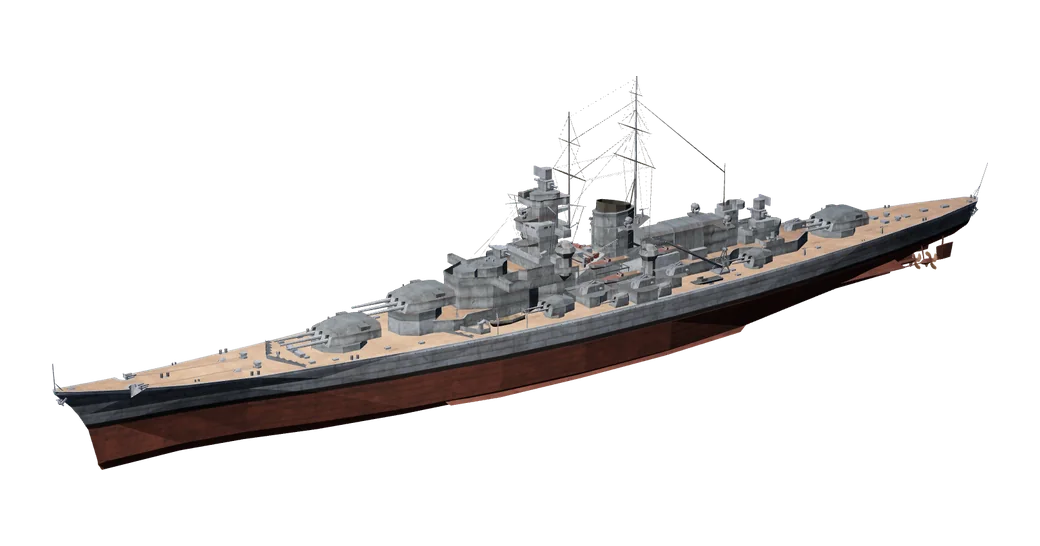
Story
Commissioned in 1939 as the lead ship of the Scharnhorst class, she carried 3 triple 28 cm turrets.
In June 1940 she sank the British aircraft carrier Glorious together with Gneisenau, and in February 1942 she returned to Germany through the English Channel.
She sank at the Battle of the North Cape in December 1943, and only 36 of her 1,968 crew survived.
Name origin
Gerhard von Scharnhorst (1755–1813), a Prussian military reformer
Battles
- Sinking of Rawalpindi (November 1939) — Sank the British armed merchant cruiser Rawalpindi after a brief fight
- Operation Juno (8 June 1940) — Sank the British aircraft carrier Glorious and 2 destroyers together with Gneisenau · a destroyer's torpedo killed 48 of her crew
- Operation Berlin (February–March 1941) — Sank 6 merchant ships (35,080 GRT) in the Atlantic
- Channel Dash (11–12 February 1942) — Struck 2 mines while returning to Germany through the English Channel
- Battle of the North Cape (26 December 1943) — Sank fighting the British battleship Duke of York
Good to know
- Her original straight stem was replaced with a raised 'Atlantic bow'
- In September 1943 she shelled a battery on Spitsbergen (Operation Zitronella)